What VCs Want to See in Your GTM Plan (Hint: It’s Not Just Revenue)

If you’re a founder of a cybersecurity startup, you might think VCs only care about one thing: revenue. While showing strong sales numbers is important, venture capitalists dig deeper when they evaluate your go-to-market (GTM) plan. Simply put, your GTM strategy is one of the most scrutinized parts of your pitch — and vague ideas like “we’ll figure out marketing later” won’t cut it.
VCs want to see that you understand not just how to make money, but how you’ll make money repeatedly, sustainably, and at scale. They want to believe your team can navigate the complex cybersecurity landscape, outmaneuver competitors, and build a sales and marketing engine that grows efficiently over time.
What VCs Are Actually Looking For.
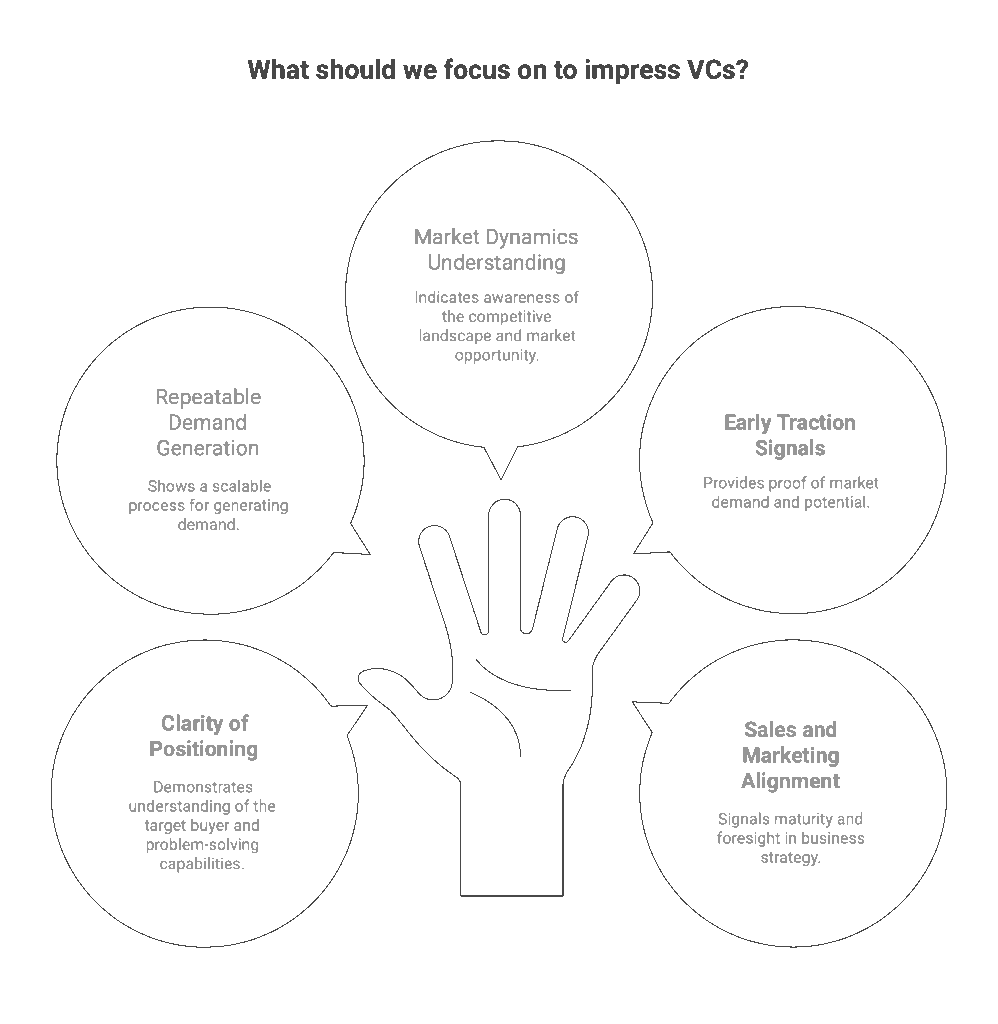
So, what’s behind the scenes of a compelling GTM plan? Here are the key elements investors focus on beyond just your revenue figures:
Clarity of Positioning VCs want to see a deep understanding of your buyer. Who exactly are you selling to? What specific pain points are you solving? Why is now the right time to tackle this problem? And critically — why is your founding team uniquely suited to deliver the solution?
Repeatable Demand Generation Motion One-off sales or pilot deals won’t impress. VCs want to know you have—or are building—a repeatable, scalable process to generate demand. This could be through inbound marketing, targeted outbound campaigns, channel partnerships, or a combination. The key is that your motion is predictable and can be scaled.
Market Dynamics Understanding Are you aware of the competitive landscape? How crowded is the space? What are your differentiators? Can you articulate the size and growth of the market opportunity? A strong GTM plan shows you’ve done your homework and understand where your startup fits.
Early Traction or Signals Even if your ARR is still modest, what early signals suggest demand? Pilot wins, strong demo engagement, customer references, or a waitlist can all serve as proof points. These are essential for convincing VCs that the market wants what you’re building.
Sales and Marketing Alignment (or a Plan for It) VCs often see startups hire sales reps before figuring out their messaging or marketing strategy — a recipe for chaos. Showing that you have a plan to align sales and marketing efforts, even if you don’t yet have dedicated teams, signals maturity and foresight.
Where Technical Founders Often Miss the Mark.
Founder-led cybersecurity startups face unique challenges in GTM execution — especially when the founding team is highly technical but less experienced in marketing and sales. Here’s where many stumble:
- Over-reliance on founder-led sales: Founders can only stretch so far. Without a scalable GTM plan, growth plateaus.
- No clear Ideal Customer Profile (ICP): “We sell to all cybersecurity teams” is too vague. Defining specific buyer personas is critical.
- Feature-focused positioning: Talking about your product’s technical specs won’t convince investors or customers. Outcomes and value matter more.
- Underestimating VC expectations: VCs want to see a scalable growth story, not just passion or technical brilliance.
- Missing the bridge from early traction to scalable GTM: Pilot customers are great, but what’s the plan to reach thousands more?
How to Build a VC-Ready GTM Plan: Step-by-Step Tactics.
Here’s how to sharpen your GTM plan with concrete, actionable tactics that VCs actually want to see — and how to set your startup up for scalable growth.
1. Define a Laser-Focused Ideal Customer Profile (ICP).
Most startups say their customers are “cybersecurity teams” or “IT departments.” That’s too broad, and VCs know it.
Why it matters: Your ICP helps you focus marketing and sales on the prospects who are most likely to buy and stick around. Without it, your GTM efforts are scattered, inefficient, and harder to scale.
How to do it:
- Step 1: Identify the buyer persona — Who makes the purchase decision? For cybersecurity tools, this could be CISOs, security architects, or IT directors.
- Step 2: Detail their pain points — Are they struggling with endpoint protection, compliance audits, or threat detection?
- Step 3: Define firmographics — company size, industry vertical, geography. For example, mid-market financial firms with compliance challenges.
- Step 4: Understand buying triggers and objections — Do they prioritize cost savings, integration ease, or vendor reputation? What’s holding them back?
Quick exercise: Interview 3 current or potential customers and fill out a one-page ICP worksheet. Focus on who bought or showed interest and why.
2. Craft a Clear, Outcome-Focused Value Proposition.
Technical founders often default to describing what their product does, but investors want to hear why it matters — the business outcome.
Why it matters: VCs fund startups that solve clear, urgent problems. Your value prop should translate technical features into measurable benefits.
How to do it:
- Step 1: Start with this formula: “We help [ICP] achieve [specific outcome] by [unique differentiator].”
- Step 2: Quantify where possible — Will you reduce breach response time by 40%? Cut audit prep from weeks to days?
- Step 3: Test it on non-technical colleagues or investors. If they don’t get it immediately, refine.
Example:
“We help mid-sized healthcare CISOs reduce compliance audit prep time by 60% through automated data aggregation — speeding time-to-certification and reducing risk.”
3. Map Out a Repeatable Demand Generation Motion.
VCs want proof you can generate leads and pipeline predictably — not just close a handful of pilot deals. Why it matters: Without a repeatable motion, scaling is guesswork.
How to do it:
- Step 1: Identify top 2–3 demand channels. For cybersecurity startups, common ones include targeted LinkedIn campaigns aimed at CISOs, hosting webinars on compliance challenges, or participating in industry events/webcasts.
- Step 2: Create simple, measurable workflows for each channel. Example for LinkedIn ads: Audience targeting → Ad copy → Landing page with a demo signup → Follow-up emails
- Step 3: Track KPIs like click-through rate (CTR), demo requests, and conversion to meetings.
- Step 4: Iterate monthly based on results.
- Quick tip: Use tools like HubSpot, Pardot, or even simple spreadsheets to document and measure these workflows.
4. Use Early Traction and Customer Signals as Proof Points.
You don’t need millions in ARR yet, but you do need to show evidence the market wants what you’re building. Why it matters: VCs look for traction signals that reduce their risk.
How to do it:
- Step 1: Collect and organize data on early wins: pilot customers onboarded, repeat demo requests, positive feedback or case studies, number of trials or PoCs in progress.
- Step 2: Track common objections or questions — these are gold for refining your messaging.
- Step 3: Present this data in your GTM section with simple metrics — e.g., “3 pilot customers representing $150K ARR pipeline” or “20 qualified demo requests in last 60 days.”
5. Align Sales and Marketing — Even If It’s Just a Plan
For startups without formal marketing teams, VCs want to see a clear plan for aligning these functions.
Why it matters: Sales and marketing misalignment leads to wasted resources and missed opportunities.
How to do it:
- Step 1: Identify your early sales motions — founder-led calls? SDR outreach? Channel partnerships?
- Step 2: Define the key messaging and collateral marketing will provide — one-pagers, case studies, email templates.
- Step 3: Build a timeline for hiring or engaging fractional resources — for example, a fractional CMO or marketing consultant for 3–6 months.
- Step 4: Use simple tools like shared CRM notes or Slack channels to keep communication clear.
Turn Your GTM Strategy Into Investor Confidence.
Building a VC-ready GTM plan is challenging when you’re a technical founder juggling product development, fundraising, and early sales. The strategic depth required—from ICP refinement to demand generation systems—often exceeds what founders can tackle while wearing multiple hats.
This is where fractional marketing leadership makes the difference. Rather than hiring a full-time CMO before you’re ready, or struggling with tactical gaps that hurt investor confidence, fractional support provides the strategic expertise to build and execute a GTM plan that scales.
As a Fractional CMO, I partner with cybersecurity founders to:
- Refine your ICP and value proposition based on customer data and market research
- Build repeatable demand generation motions that create predictable pipeline
- Develop sales and marketing alignment frameworks that scale beyond founder-led efforts
- Create investor-ready GTM documentation that demonstrates strategic thinking
For startups needing lighter-touch support, our Advisory Service provides:
- Monthly strategic guidance on GTM challenges
- GTM plan reviews and optimization recommendations
- Access to proven frameworks and templates
- Ongoing consultation as your strategy evolves
The difference between startups that raise successfully and those that struggle often comes down to GTM execution credibility. Investors can spot the difference between tactical hustle and strategic planning. Ready to build a GTM plan that impresses investors and drives growth?
Book a free discovery call where we’ll review your current GTM approach, identify the gaps that concern VCs most, and explore how fractional marketing leadership can accelerate your fundraising and growth goals. [Schedule your discovery call →]